Individuals
Privacy driverSovereignty over personal messages, health, finance, thoughts, web searches, correspondence....
Compliance driverLight (GDPR)

Your data is exposed, with no control over the AI work parameters, limitations, memory and functionality.
ThirdAct treats that relocation of ownership as the central problem to solve.
We invert the frontier models' approach. "Sovereign" means the user holds control, ownership, and privacy over the AI itself and its functionality, not a license to query someone else's model.

The user runs the AI, its functionality, connectivity, memory, context, ethics, guardrails etc.. No government kill switch can terminate a model or a function (e.g. Claude Fable 5). No external party shapes how the AI is used.

The model is local running either on-device inference, private cloud, or a controlled hybrid that reaches a frontier model only for the rare task that needs more compute, and only through an anonymized pipe. By default, over 90% of consumer and enterprise AI tasks will be performed by local open-weight models with no information leaving to an outside vendor.

The AI's accumulated knowledge, context, and capabilities belong to the user. These are local, cannot be used for training AI or as advertising meta-data.

Full private encryption. Keys and permissions are held entirely by the user.
The harness is customized and personalized around one user, not averaged for the multitudes as "all things to all people".

AI's first three years (2023 to 2026) ran as a global pilot or a proof-of-concept by all AI users. At that stage privacy and sovereignty were not a pre-requisite. Lack of sovereign private use was tolerated, accepted because "pilots" are temporary.
Now, the pilot phase is over. Individuals, corporations, and countries made AI part of their lives. However, AI terms of use will no longer stay in "pilot" mode. Most users and (definitely) corporations will never agree for their most intimate information such as medical records, communications, financial data, etc., to be shared with the vendors that run the frontier AI models.

PAAI is the unique sovereign-AI platform harness we've built that enables rapid development and deployment of sovereign-AI software.
In the AI stack the LLM models (e.g. Claude Fable 5 and other frontier models) are the brain, and the harness is the other 95% of software that operates the model: memory, context, persona, tools, capabilities, persistence, skills and the judgment about when to act.

PAAI is an LLM-agnostic sovereign harness by design, built to serve from a single user to a multinational enterprise or a country. The model at the core is replaceable as model evolution and user preferences change. The harness, and everything it accumulates around the user, is the constant asset that survives every model swap.

The harness, and everything it accumulates around the user, is the constant asset that survives every model swap.
The main differentiators of ThirdAct from Frontier Model vendors
Four main pillars mark how ThirdAct splits from the frontier. Everything below hangs off them.
The frontier models averaged one harness down to be all things to all people: one assistant for a teenager, a law firm, and a government, with the payment tier the only real distinction. ThirdAct flips the chart. A user is the entity that holds the AI's full attention: a person, a business, an enterprise, a community, or a country.
This changes the relationship, not just the product. Tool-thinking fit the old software. A word processor or a spreadsheet demanded the user's attention and a learning curve, and never knew the hand on the keyboard. In the AI era the right frame is collaboration: a partnership between human and AI that compounds with familiarity and builds a stronger usability arc, a digital bond, over time.

Sovereign AI is private. AI reasoning creates understanding, knowledge and user-specific insights which are all a new asset class. These private assets are currently shared with and used by frontier model vendors on public SaaS AI that reads them, trains on them, or feeds them to advertising.
For enterprises it becomes even more acute: they must have a full control of the AI, assure regulatory compliance, maintain internal confidentiality, retain an immutable paper trail and set ethical guardrails. They will not adopt the internal use of AI in full until these minimum standards are met. Privacy here carries three senses, all default in every ThirdAct product:
This approach enables a completely different, sovereign use of AI across all segments.

Frontier AI is passive by design: it waits for a prompt, answers, and forgets. A chat box saying "ask me anything" is a blank surface that means nothing to most people, which is why Meta's WhatsApp AI and Microsoft Copilot are the documented reference failures.
PAAI runs the other way. The harness has built in "knowledge harvesting" directive around the user and in time it already knows the user ecosystem, work, home, influence circles, social circles, the projects, the priorities, the tone, deadlines and goals. It does not sit and wait.
Its "heartbeat" is a continuous loop system that watches context, completes tasks, runs towards goals, learns from its own hits and misses, and acts before it is asked. It surfaces the reminder, the draft, the warning, or the next step at the moment it matters, and stays silent when nothing does. PAAI delivers proactive sovereign AI to all user tiers.

Frontier models learn the way Yann LeCun has spent years warning against: next-token prediction over text scraped from everyone, compressed into one averaged model, with blanket guardrails that know nothing about the person typing.
PAAI builds a significantly richer user-centric world model comprised of multi-sensory inputs (text, visuals, audio, ecosystem, spatial and temporal awareness, context graph and relations), all user-related, learned by observing reality in an abstract representation space (JEPA). PAAI trains a world model on a single user's sensory stream: their texts, images, audio, screens, places, people, relationships, goals, fears, threats, preferences and timing, held together as one interconnected context.
With PAAI:

Frontier models are trained on user-data for the benefit of the vendor. PAAI learns from user-data for the benefit of the user alone.
Sovereignty runs on a gradient. Every user can choose the level of "Sovereign AI" to implement. Each tier further removes dependency on an outside vendor, and the system moves along it without rewrites. The same substrate, with more of it held by the user at every step.
Our roadmap supports the entire technological tiers range of AI sovereignty. At the bottom sits today's default: the vendor owns the whole stack and the user owns only the prompt. Every ThirdAct step moves ownership of the stack (model, device, operating system, silicon) one tier further toward 100% sovereign control by the user.

Ownership ledger. What the user owns at each tier (● user-owned, ○ vendor-owned):
| Dependency | 00 · Cloud | 01 · Device | 02 · Hybrid | 03 · On-prem | 04 · RISC-V |
|---|---|---|---|---|---|
| Model | ○ | ● | ● | ● | ● |
| Device | ○ | ○ | ● | ● | ● |
| Operating system | ○ | ○ | ○ | ● | ● |
| Silicon | ○ | ○ | ○ | ○ | ● |
ThirdAct's every release of PAAI moves the boundary one step further from the vendor, with no rewrite of the substrate to get there.
Privacy driverSovereignty over personal messages, health, finance, thoughts, web searches, correspondence....
Compliance driverLight (GDPR)

Privacy driverBookings, financial struggles, trade secrets, customer data, internal IP
Compliance driverLight (GDPR, sector-specific)

Privacy driverCommercial espionage, operational continuity, regulatory exposure, jurisdictional risk, intellectual property, business processes, vendor exclusivity
Compliance driverHeavy (SEC 17a-4, FINRA, MiFID II, FCA, FINMA, HIPAA, DORA, NIS2, eIDAS 2.0)

with no private-data exposure.

into any content.

over AI function and integration with other systems.
For fifty years, software put the application at the centre and made the human adapt to it. AI is the moment that inverts. It moves from a passive box bolted onto each program, to a harness that embeds inside and orchestrates every application, and finally to the operating system itself. Three stages, one direction: the user at the centre.
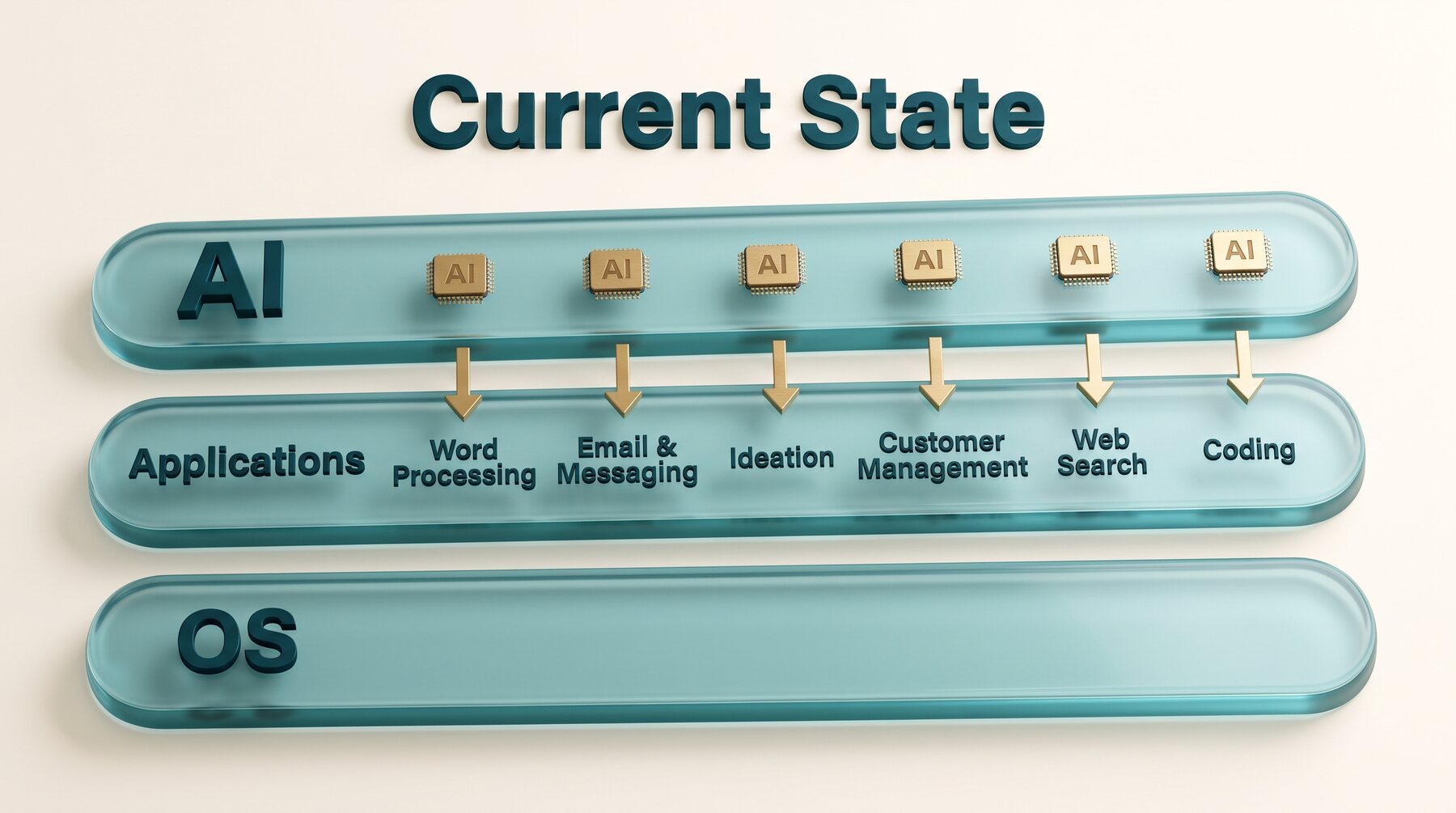
Today AI is bolted on. Every application, word processing, email and messaging, ideation, customer management, web search, coding, gets its own separate AI: a passive chat window pinned to the side of a tool that was never built for it. The AI does not understand the application's data or flow. It waits for a prompt, answers in isolation, and forgets. Six apps means six disconnected assistants, none aware of the others, none aware of you.
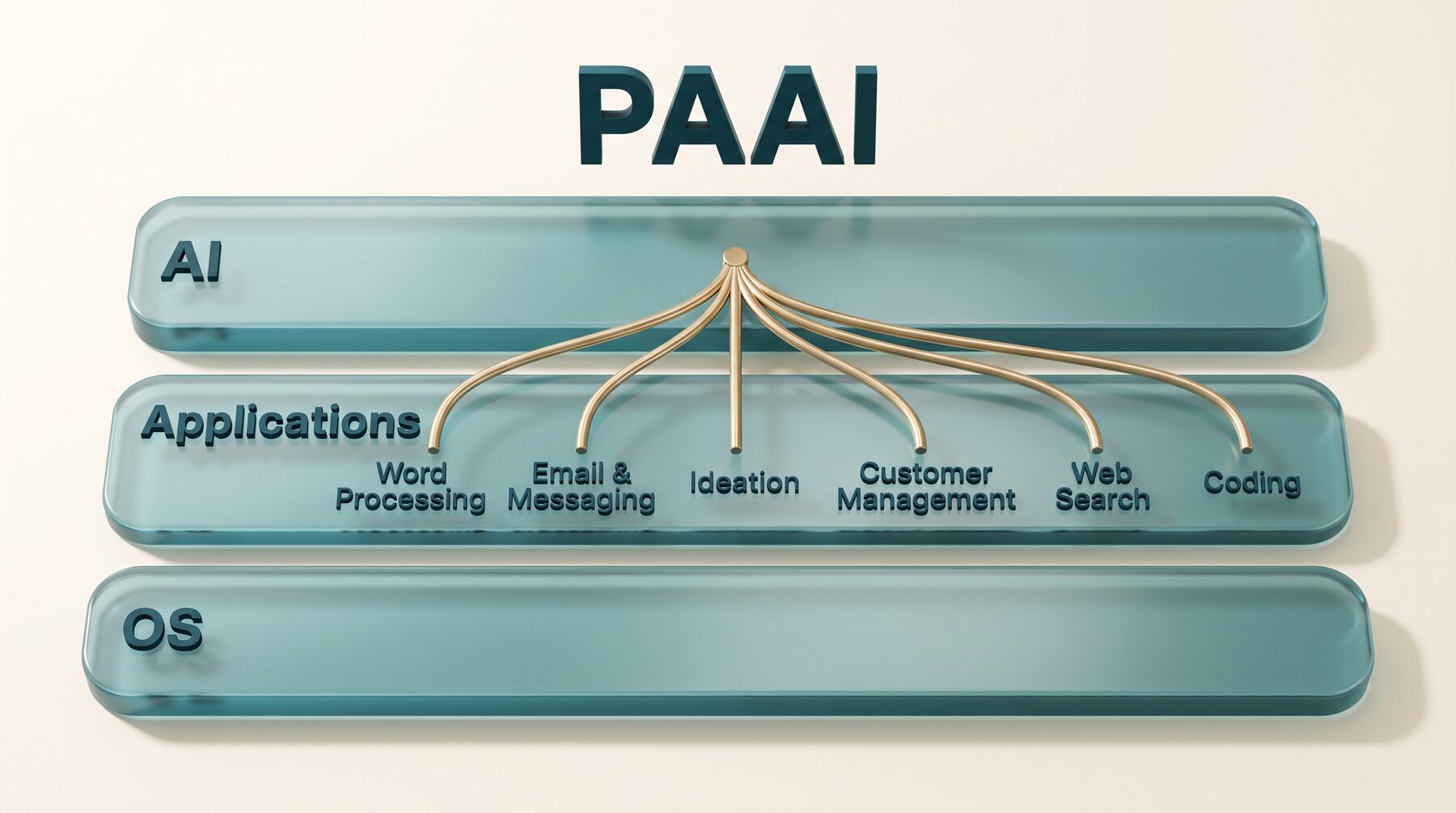
PAAI inverts the attachment. Instead of a chat bolted onto each app, one sovereign AI harness embeds inside every application and orchestrates across all of them. It works within each app's own data and flow as a proactive agent, and it wires the apps to one another, carrying context from an inbox to a document to a CRM. One intelligence runs the whole surface, drives customer journeys and business flows end to end, and answers only to you. Applications stop being islands and become a coordinated system with the user at the centre.
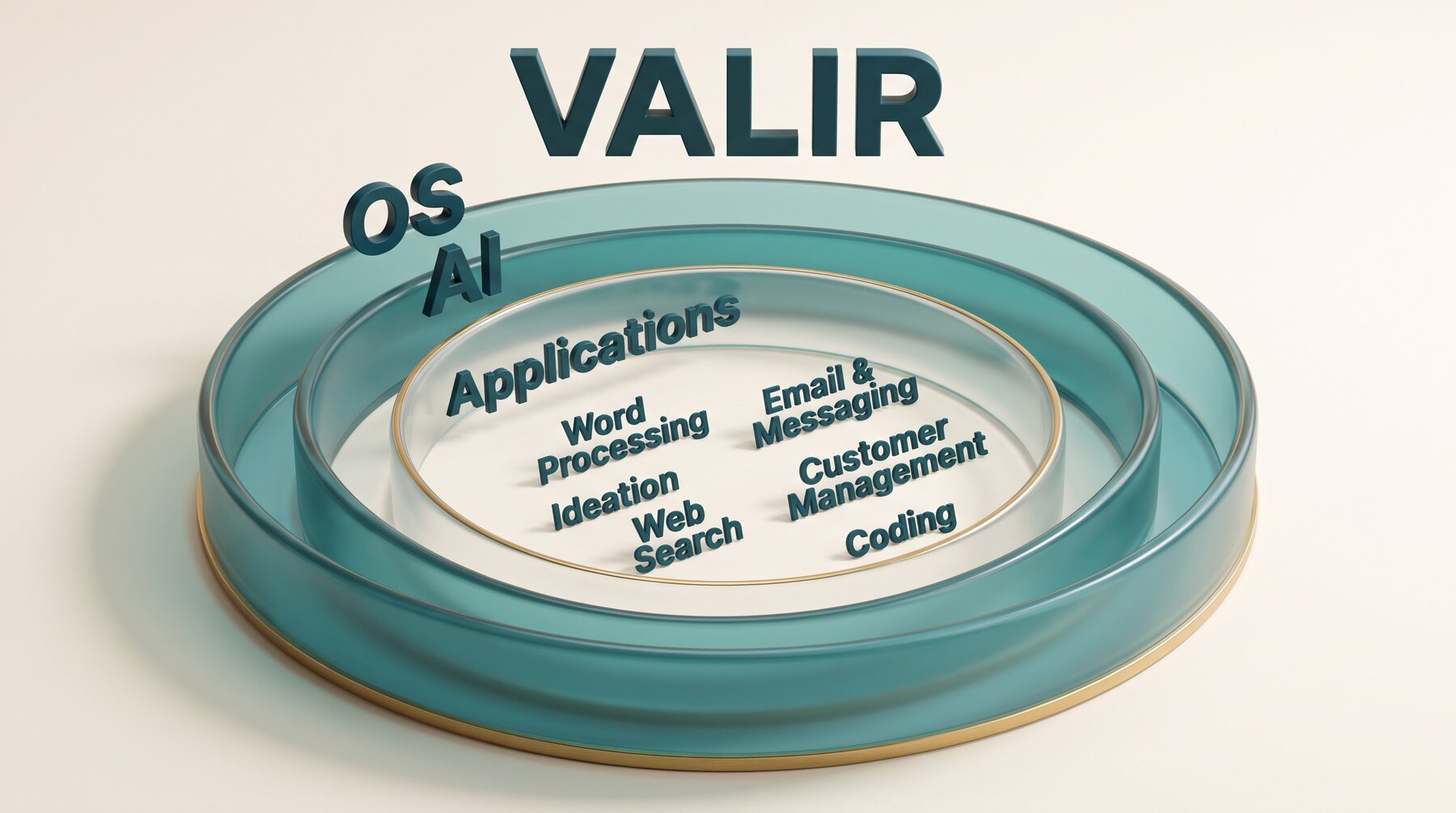
VALIR is the end state: AI as the operating system itself. The application boundary dissolves. Word processing, messaging, ideation, customer management, search and coding stop being separate programs and become capabilities the AI-OS composes on demand around your intent. You state what you want; VALIR assembles the capabilities to deliver it, wrapping the OS, the AI and every application into one integrated whole. What the system is built around is no longer the app. It is the user's intent.

Private AI activity. No cloud uploads.
LLM-agnostic. All reasoning is local.
Advanced RAG; vector index + entity graph for rapid retrieval.
Companion attitude, not a "help desk" assistant.
User-customizable personality traits.
Reads, responds, analyzes without prompts on each message in / out.
Speaks in own-chat, any user-chat, modals, alerts & artifacts.
Familiarity data (names, family, friends, dates, locations, goals).
Time-aware with an algorithmic heartbeat.
Location-aware via encrypted on-device GPS heartbeats.
On top of UI/UX familiarity and ease of migrating all WhatsApp messages and media, PAAI gives OBLIQ what WhatsApp cannot match:

Reminds the user that the basketball he promised his son a week ago is due tomorrow, and shows nearby stores that have it in stock.

Assemble all work/family related action items from all messages of last 30 days.

Flags a stranger mistakenly added to a group chat before sensitive messages go out.

Holds a profane message before it lands in a group that includes children.

Collects related items across every conversation into live lists.

Partners on writing flow, tone, and phrasing. Not a passive rewrite bot.
OBLIQ is the first of a series of PAAI commercial apps. Each PAAI application presents a modern, private alternative to a mass-market app that has gone unchallenged for decades.

VALIR is the evolution beyond PAAI. PAAI is an application-level substrate: applications and enterprise systems run privately on top of it. VALIR is an operating-system-level substrate, a full reversal of legacy OS architecture.
Legacy operating systems are application-centric. Each app (Excel, Word, a CRM) takes center stage and demands its own UI and its own learning curve. The user adapts to the technology. Today's AI follows the same path, bolted onto a legacy OS as Claude for PowerPoint, Claude for Excel, Claude Code, each one segregated and wired through endless APIs, SDKs, MCPs, and connectors.
VALIR inverts it. AI becomes the operating system's orchestrator and the mediation layer for both function and interface. Applications dissolve into capabilities that arrive at the user's intent and act when needed. The spreadsheet capability lives inside any document, the same as image editing or research. The user never leaves the document to open a browser, Excel, or Photoshop. Everything centers on the user, not the reverse.